
Last Updated: November 5, 2026
Quick Summary
Procurement costs are the total amount a shop spends to source, order, receive, store, and use materials, not just the invoice price. Freight, admin time, storage, rush shipping, and downtime all stack on top of the unit price. Comparing quotes on price alone hides these costs, so evaluate suppliers on total cost of ownership instead.
- Group spend by category and ask for tiered pricing tied to committed monthly or quarterly volume.
- Never sign a volume floor you cannot hit in a slow quarter, since missed commitments can trigger retroactive repricing.
- Track spend by supplier, on-time delivery, stock levels, and cost per job on a simple spreadsheet dashboard.
- Keep a qualified backup supplier for each critical category so a primary source faltering is not an emergency.
- Automate recurring orders so critical supplies arrive on schedule and no one improvises a workaround.
Table of Contents
- Where Procurement Costs Actually Come From in a Manufacturing Shop
- Supplier Negotiation Strategies for Manufacturers That Hold Up Over Time
- Total Cost of Ownership in Procurement: The Number That Decides the Deal
- Manufacturing Inventory Management Best Practices That Free Up Cash
- Building a Procurement Dashboard for Manufacturing Shops
- Cutting Maverick Spending and Automating the Procurement Workflow
- The Angles Most Cost-Reduction Plans Miss
- Request a Quote and Put Your Recurring Supply on Autopilot
- Frequently Asked Questions
Where Procurement Costs Actually Come From in a Manufacturing Shop
Most shop owners think they know what they spend. Few do.
Procurement costs are the total amount a shop spends to source, order, receive, store, and use the materials it needs to operate. That includes far more than the invoice price.
The unit price on a quote is only one number in the equation. Freight, handling, rush charges, storage, and admin time all stack on top.
The Hidden Line Items Behind Every Purchase Order
Every purchase order carries costs that never appear as a line item. They sit in the work around the order.
- Freight and handling fees on small, frequent orders
- Admin time to raise, approve, and reconcile each PO
- Storage space tied up by over-ordering
Add those up across a year and they often rival the material spend itself. A shop placing many small orders pays for that habit in freight and staff hours.
Why Unit Price Is the Smallest Number on the Quote
A low unit price can hide a bad deal. The real question is what the item costs once it reaches the bench and gets used.
Consider two suppliers quoting the same sanding disc. One sells cheaper per box but ships in small lots with freight added. The other costs a little more per box but delivers on a set schedule with no per-order freight.
The second often wins. Fewer orders mean less admin, less freight, and fewer stockouts. That is the shift from unit price thinking to total cost thinking, and it changes every buying decision.
Supplier Negotiation Strategies for Manufacturers That Hold Up Over Time
The best supplier negotiation strategies for manufacturers focus on volume commitment and reliability, not one-off discounts. Treat negotiation as a design problem: build an agreement that makes it cheaper for the supplier to serve you, then ask for a share of that savings.
- Group your spend by category and see where volume is concentrated
- Ask for tiered pricing tied to committed monthly or quarterly volume
- Negotiate delivery terms, not just price
- Set clear lead times and stock guarantees in writing
- Review the agreement each quarter against actual usage
What most guides miss is that use comes from predictability. A supplier will price better for a shop that orders the same items on a set schedule. Reliable volume is worth more to them than a single large order.
The Specific Levers That Move Price
- Volume commitment with a floor. Offer a minimum monthly spend or unit count in exchange for a locked price tier.
- Order frequency and drop size. Committing to fewer, larger drops reduces the supplier’s pick-pack and freight cost. Ask for that saving as a per-order freight cap or waived small-order fee.
- Payment terms. Paying by pre-authorized debit or on a shorter cycle is worth real money to a supplier’s cash flow. Trade faster payment for a percentage off the invoice or free delivery.
Watch out: never sign a volume floor you cannot hit in a slow quarter. A missed commitment often triggers retroactive repricing on everything you bought, which can wipe out the savings.
What to Put in Writing
A verbal deal erodes the first time someone new places an order. Put the mechanics in the agreement: price tiers and the volume bands that trigger them, lead times by item, a stock guarantee for critical consumables, the backup-source clause, and a quarterly review date. Keep at least one qualified backup supplier per critical category so a primary source faltering does not become an emergency purchase.
Small-Shop Tactics That Punch Above Their Weight
A shop with one buyer and no procurement department cannot run a formal request-for-proposal cycle. It can still do three things well: consolidate to two or three suppliers per category so each relationship is worth negotiating; use a recurring shipment schedule as the commitment that earns better pricing; and review usage data quarterly so the next conversation is grounded in actual numbers.
Total Cost of Ownership in Procurement: The Number That Decides the Deal
Total cost of ownership in procurement is the full cost of an item across its life, from purchase through use and disposal.
Run this simple calculation before you commit to a supplier:
| Cost Component | What to Include | Why It Matters |
|---|---|---|
| Unit price | Cost per item or box | The starting point only |
| Freight | Per-order and rush charges | Rises fast with small orders |
| Admin | Staff hours per PO | Hidden but real |
| Storage | Space and handling | Ties up cash and floor space |
| Downtime | Lost output from stockouts | Often the biggest cost |
A supplier with a slightly higher unit price but predictable delivery can beat a cheaper one once these rows are filled in. The Chartered Institute of Procurement & Supply guidance frames this as looking past the purchase price to the full cost of ownership.
Manufacturing Inventory Management Best Practices That Free Up Cash
Strong manufacturing inventory management best practices come down to one idea: hold enough to run, not so much that cash sits on a shelf. Inventory is cash you cannot spend elsewhere.
- Track usage by item and set reorder points from real numbers
- Buy consumables in bulk where storage allows
- Use demand aggregation to combine orders across jobs
For shops buying consumables in bulk, the trick is matching order size to storage and cash flow. Our guide on how to buy bulk sanding supplies for cabinet shops walks through that balance in detail.
Building a Procurement Dashboard for Manufacturing Shops
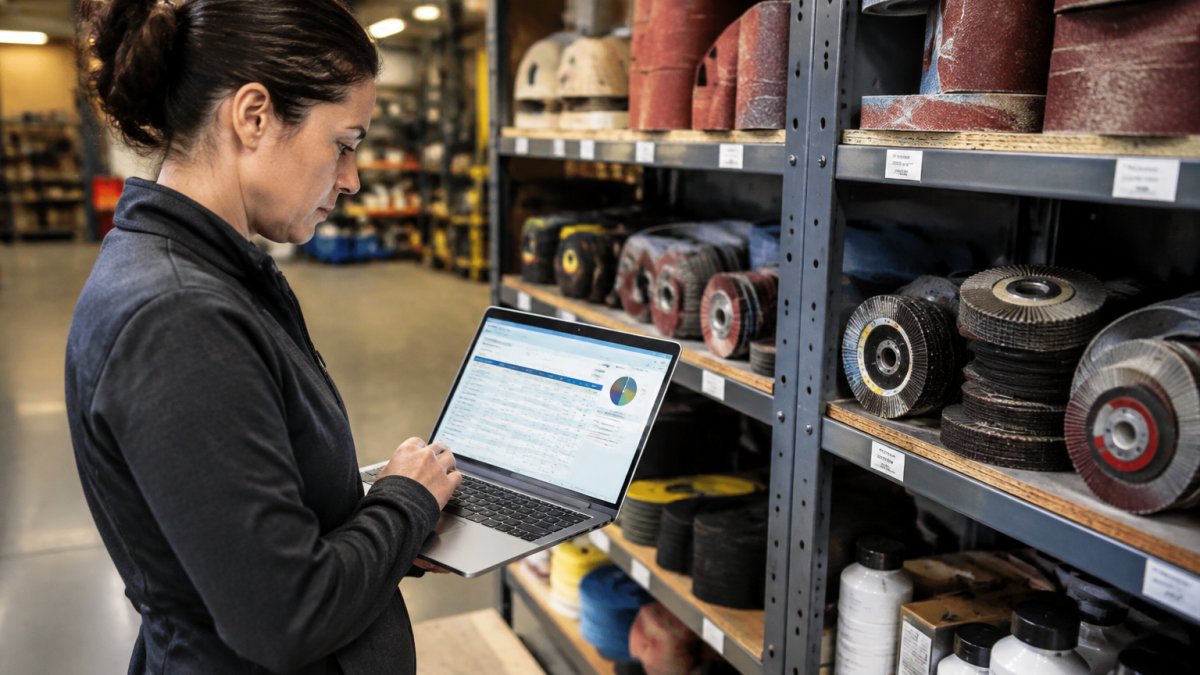
A procurement dashboard for manufacturing shops should track spend by supplier, on-time delivery, stock levels, and cost per job. The same spreadsheet can reveal where energy storage affects job costs, making optimizing battery procurement part of the shop’s broader effort to control spend.
The Five KPIs That Earn Their Keep
Start with a handful of procurement KPIs, and define each one so the number means the same thing every month:
- Spend by category and supplier. Total invoiced dollars per month, grouped by category (abrasives, fasteners, safety, etc.) and by supplier. This is the base layer; everything else hangs off it.
- On-time delivery rate. Lines received on or before the promised date divided by total lines received. Track it per supplier, not shop-wide, so you can act on it.
- Stockout incidents per month. Count each time a critical item hit zero and forced a substitution, a rush order, or a work stoppage. One number per incident, with the item and date noted.
Keep it simple. A spreadsheet beats a fancy tool nobody updates. The failure mode is a dashboard that takes two hours a week to feed; within a month it is stale and ignored.
A Low-Cost Build Sequence
- Start with exports, not data entry. Pull monthly purchase history from your accounting or point-of-sale system into a spreadsheet. If you order through a supplier portal, export the order history there.
- Tag every line with a category. A short category list (10 to 15 buckets) is enough. Do this once and reuse it.
- Add the two operational columns. Promised date and received date let you calculate on-time delivery without new systems.
- Build one summary tab. Spend by category, spend by supplier, on-time rate by supplier, and stockout count. Four small tables, refreshed monthly.
- Review on a fixed cadence. A 30-minute monthly review against the prior month is what turns the dashboard into decisions.
Watch out: do not let the dashboard become a reporting exercise for its own sake. If a metric has not changed a decision in three months, drop it and keep the four that have.
Where This Fits the Small-Shop Workflow
A shop with limited staff can treat the dashboard as a negotiation and reorder tool. The spend-by-supplier table tells you where consolidation will pay. The on-time rate tells you which supplier is costing you downtime. The stockout log tells you which items need a par level or a recurring shipment. If you want a deeper build, our procurement dashboard guide covers what to track and how to set it up.
Cutting Maverick Spending and Automating the Procurement Workflow
Maverick spending is any purchase made outside the approved process, and it quietly drains budgets. Someone grabs supplies from a local store or orders off-contract, and the savings you negotiated vanish.
To cut it, make the approved path the easiest one. Automate recurring orders so the right supplies arrive on schedule without anyone chasing them. Set clear rules on who can buy what.
Consolidating Suppliers Without Creating a Single Point of Failure
Consolidating suppliers cuts admin and improves pricing, but do not put everything on one vendor. Keep a qualified backup for each critical category. The goal is fewer, stronger relationships with a safety net, not a single fragile chain.
Automation ties this together. A recurring shipment schedule means critical items restock themselves, so no one improvises a workaround. Our walkthrough on how to automate recurring industrial supplies shows the setup step by step.
The Angles Most Cost-Reduction Plans Miss
Most cost-reduction plans stop at price. The bigger wins sit in three places: waste, risk, and downtime.
Waste reduction and lean manufacturing principles cut cost by removing what you never needed to buy. Risk management in supply chains protects you when a supplier falters.
For a metal shop, a single stockout on a critical grinding item can idle a bay for hours. That lost output dwarfs any per-box savings.
Sustainability, Risk and AI in Small-Shop Procurement
Sustainability-driven cost reduction works because less waste means less spend. Right-sizing orders and cutting overbuying helps the bottom line and the environment at once.
Risk management means knowing your backup sources before you need them. AI-driven predictive procurement is starting to help small shops forecast usage, though it still needs clean data to be useful. Start with a simple usage log before reaching for software.
If downtime is a hidden cost in your shop, our guide on ways to reduce downtime in metal fabrication shops covers where it hides. And for a broader view of how procurement fits into shop efficiency, see our steps on improving efficiency in small woodworking shops.
Request a Quote and Put Your Recurring Supply on Autopilot
Cutting procurement costs is not about squeezing every quote. It is about seeing the full cost, negotiating on reliability, and removing the waste and downtime that never show up on an invoice.
At IBEX Enterprises, we built our platform for purchasing professionals who want exactly that. Automated recurring shipment subscriptions keep critical abrasives and tools stocked on a set schedule.
Ready to stop firefighting your supply? Get started with IBEX Enterprises and put your recurring supply on autopilot.
Frequently Asked Questions
How can manufacturing shops reduce procurement costs without switching suppliers?
Start with spend visibility. Pull twelve months of purchase orders and group them by category and supplier so you can see where volume is fragmented. Then negotiate on the combined volume rather than line by line, and ask for terms that matter to your cash flow, such as net-30 or net-60 payment. Consolidating orders into fewer, larger shipments also cuts freight and admin time.
What is the difference between purchase price savings and total cost savings?
Purchase price savings is the gap between what you paid before and what you pay now for the same item. Total cost savings adds everything around that price: freight, duties, storage, spoilage, downtime when stock runs out, and the labor hours spent ordering and reconciling invoices. A cheaper abrasive that loads up faster or wears out sooner can cost more per finished part than a premium one. Track cost per unit of work completed, not cost per box, when you compare options.
How do you calculate procurement cost savings?
Use a baseline you can defend. Take the prior twelve months of spend for the category, adjust for volume changes, and compare it to the new run rate at the same volume. Separate hard savings, which show up as a lower invoice, from cost avoidance, which is a price increase you negotiated away or a rush order you prevented. Report both, but label them clearly. A simple formula is baseline spend minus current spend at constant volume, divided by baseline spend, expressed as a percentage.
How can a procurement dashboard for manufacturing shops help control costs?
A dashboard turns scattered purchase orders into a single view of spend by supplier, category, and month. That makes maverick spending visible, shows which items are reordered most often, and flags when a price creeps up. For small shops, the biggest gain is time: reordering consumables from a saved list takes minutes instead of an email chain. Look for a dashboard that supports purchase order payment terms and recurring shipments, so routine restocking runs without a purchase requisition each time.