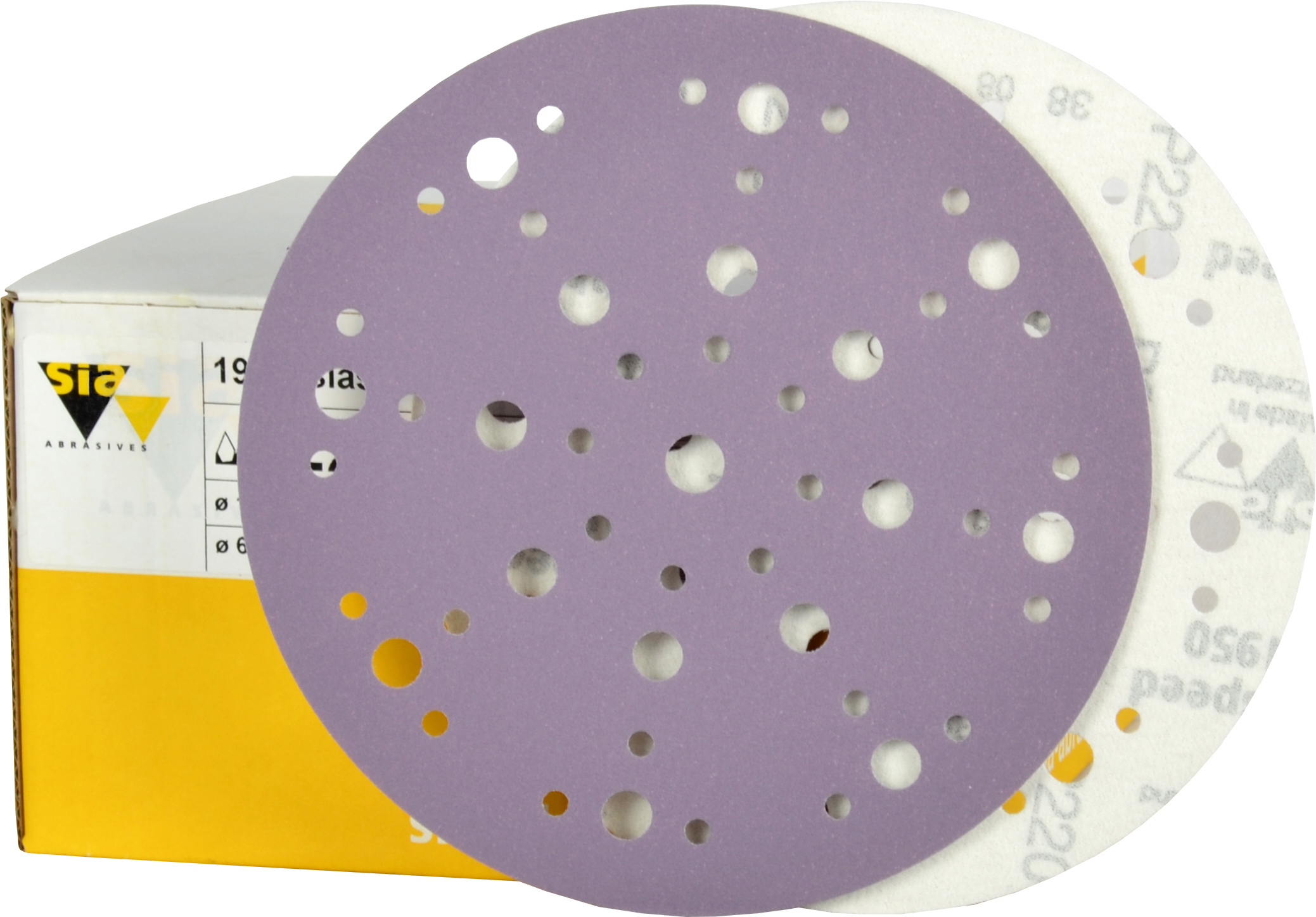
The Sia 1950 Siaspeed series is one of the most complete sanding lines we carry: 5-inch and 6-inch hook-and-loop discs, PSA discs, 25-yard rolls, sander sheets and FiboTec dust-extraction patterns, in grits from 40 to 1500. This guide covers what the Sia 1950 line is, which format fits your sander, and how to build a grit ladder with it.
Whether you work in automotive refinishing, woodworking, metal fabrication or composite finishing, the Siaspeed 1950 series offers the performance, durability and versatility professionals need. If you would rather talk it through, call us at 403-250-3399.
In this article

What is Sia 1950 Siaspeed?
Siaspeed is the coated abrasive family from Sia Abrasives built for fast, even cutting on machines and by hand. The Sia 1950 line is the version shops reach for every day on wood, primer, filler, paint and composites.
- Fast, aggressive cut with a consistent scratch pattern from one box to the next.
- Stearate coating that reduces clogging, so discs keep cutting longer on paint, primer and filler.
- Hook-and-loop, PSA and roll formats to suit almost any sander or sanding block.
- Grits from 40 to 1500, from heavy stock removal to ultra-fine finishing.
Sia 1950 formats we stock
Every listing is titled with the Sia part number, so you can match it to the box on your shelf. These are the Sia 1950 and Siaspeed families in our catalog:
| Part family | Format | Pattern / backing | Grits | Pack |
|---|---|---|---|---|
| 3886.3796 | 5? disc | Festool-compatible, hook-and-loop | 80 to 320 | 100 |
| 3817.0427 | 6? disc | 49-hole Festool, hook-and-loop | 120 to 320 | 100 |
| 8286.8318 | 5? disc | 8-hole | 40 to 600 | 100 |
| 8443.7842 | 6? disc | 81-hole | 100 to 600 | 100 |
| 1546.3150 | 6? disc | S-Performance 57-hole | 40 and 80 | 50 |
| 6783.7705 | 5? disc | ultra-fine finishing | 40 to 1500 | 50 |
| 7332.9183 | 6? disc | hook-and-loop, latex paper | 40 to 1500 | 50 |
| 6256.1639 | 6? PSA disc | ceramic aluminum oxide | 100 to 320 | 100 per roll |
| 5706.9694 | 5? PSA disc | ceramic aluminum oxide | 80 to 600 | 100 per roll |
| 5014.2229 | 2-3/4? × 25 yd roll | PSA, paper backing | 80 to 400 | 1 roll |
| 4168.1707 | 80 × 133 mm sheet | 14-hole Festool, hook-and-loop | 100 to 400 | 50 |
| 6102.6526 | Delta sheet, 100 × 147 mm | 7-hole, hook-and-loop | 120 to 400 | 50 |
The Sia 1950 sheets for the Dynabrade Dynabug II (1070.7334) come 100 per pack from 100 to 400 grit, and the FiboTec 59-hole discs (2232.0532) are listed in 100 and 150 grit. See our Sia abrasives page for the full Sia catalog.
Reading the part number
Sia part numbers follow a simple pattern. The first two groups of digits identify the product family, and the last group is the grit. For example, 3817.0427.0220 is the 6-inch 49-hole disc in 220 grit, and 8286.8318.0600 is the 5-inch 8-hole disc in 600 grit. Once you know the family you use, reordering a different grit is just a matter of changing the last four digits when you search our site.
This also makes it easy to check you have the right product before you open a new box. If the first eight digits match the box you finished, the disc will fit the same sander and pad.
Choosing the right Sia 1950 format for your sander
Match the diameter
Sia 1950 discs come in 5-inch and 6-inch sizes. The disc should match your backing pad exactly. A disc that overhangs the pad tears at the edge, and a disc that is too small exposes the pad to the work.
Match the hole pattern
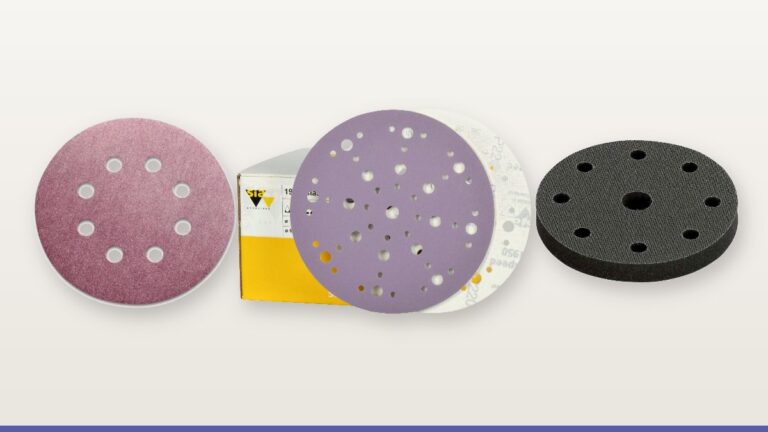
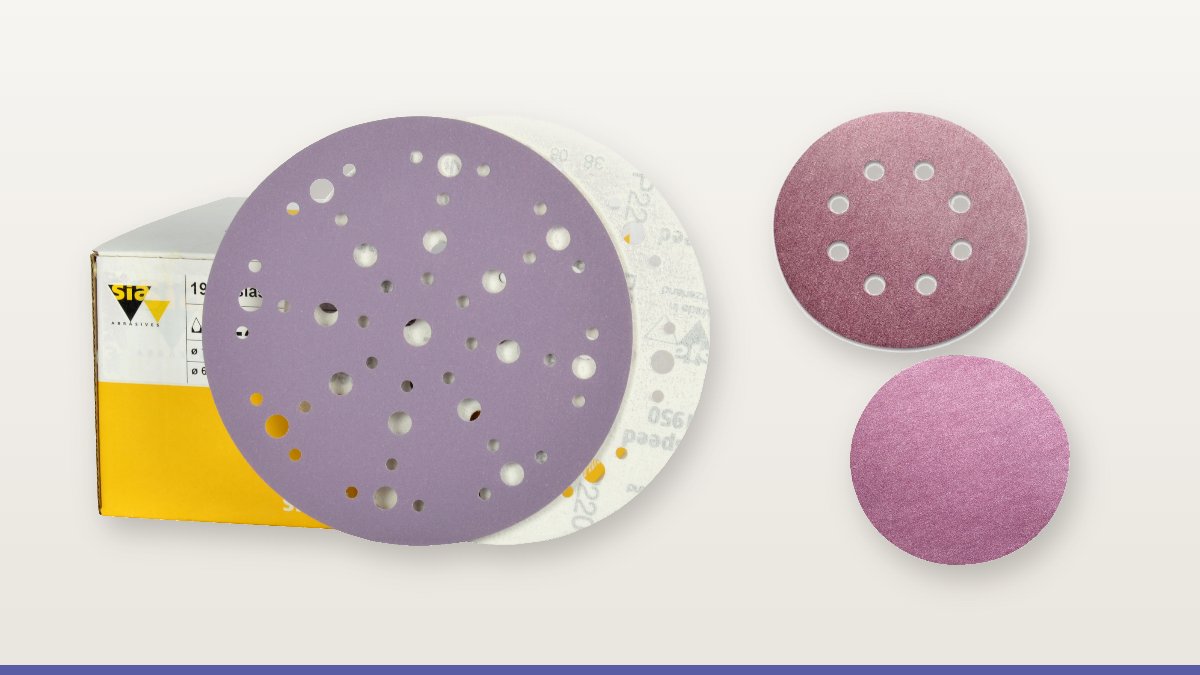
The hole pattern has to line up with the holes in your pad, or your extractor cannot pull dust through the disc. For Festool 6-inch sanders, use the 49-hole 3817.0427 discs. Most other 5-inch random orbit sanders use 8 holes, so the 8286.8318 discs are the usual choice. The 81-hole and 57-hole patterns, and Sia’s FiboTec pattern, spread extraction across more of the disc face.
Hook-and-loop or PSA
Hook-and-loop Sia 1950 discs pull off and go back on, so you can switch grits mid-job and reuse a disc that still has life. PSA discs stick to a vinyl-faced pad and stay put, which some operators prefer on production work. The PSA rolls also suit long boards and hand blocks.
Sheets and rolls
For rectangular orbital sanders and delta sanders, use the Sia 1950 sheets cut to the pad shape: 80 × 133 mm with the 14-hole Festool pattern, or the 100 × 147 mm delta. For hand sanding and long boards, the 2-3/4? × 25 yard PSA roll lets you cut exactly the length you need.
Building a grit ladder with Sia 1950
The rule is the same whatever the material: start coarse enough to remove the defect, then work up without skipping more than one grit. Here are the Sia 1950 ladders we suggest most often.
| Job | Suggested Sia 1950 grits |
|---|---|
| Bare wood before stain or finish | 80 → 120 → 180 → 220 |
| Removing old finish from wood | 40 or 60 → 80 → 120 → 180 |
| Between coats of lacquer or varnish | 320 or 400, light scuff |
| Body filler | 80 → 120 → 180 → 220 → 320 |
| Primer before basecoat | 320 → 400 → 600 |
| Clear coat defects before polishing | 1000 → 1500 |
| Steel before paint | 80 → 120 → 180 |
| Composites and gelcoat prep | 180 → 240 → 320 |
For more detail on each step, read our guide on how to choose the right sanding grit.
Sia 1950 by trade
Automotive refinishing. The stearate coating on Sia 1950 discs helps on filler and primer, where loading is the main problem. A 5-inch or 6-inch disc on a dust-extracting random orbital, from 80 on filler to 600 on primer, covers most of the prep work. For clear coat, the 6783.7705 and 7332.9183 ultra-fine discs go up to 1500.
Woodworking and cabinet shops. The Festool-pattern discs and sheets fit the most common sanders in cabinet shops, and the 120 to 220 range covers most bare-wood finishing. The delta sheets handle corners and inside edges.
Metal fabrication. For paint prep on steel and aluminum, an 80 to 180 progression on Sia 1950 discs leaves a surface paint can grip. For weld removal, a fibre disc or flap disc is usually faster; see our VSM page for those.
Composite finishing. Fibreglass, gelcoat and carbon parts need even, controlled sanding with good dust extraction. Use a pattern that matches your pad and keep pressure light so you do not cut through the gelcoat.
How Sia 1950 compares with other Sia lines
Siaspeed is the workhorse, but Sia makes several lines for specific finishing steps. We stock these alongside it:
- siaflex 1948 discs are flexible and clog-resistant, made for ultra-fine finishing and lacquer prep. Use them for the final steps after the main sanding.
- Foam-backed discs (5163.3687, 240 to 4000 grit) follow curves and soft edges without cutting through, for paint and clear coat refinishing.
- Siacarat (9967.9911) has a knitted fabric face on foam for ultra-fine matte finishing on hard, scratch-resistant surfaces, wet or dry.
- Siasponge blocks and pads handle hand sanding on contours and profiles, wet or dry.
A simple starter kit
If you are switching to this line, start small and add grits once you know what you use. Two common starting kits:
Cabinet or furniture shop with Festool 6-inch sanders: one box each of 3817.0427 discs in 120, 180, 220 and 320 grit. Add 80 if you do a lot of flattening, and a box of 4168.1707 sheets in 180 or 220 if you have a rectangular sander.
Auto body shop with 5-inch random orbits: one box each of 8286.8318 discs in 80, 180, 320 and 600, plus 6783.7705 discs in 1000 and 1500 for clear coat. Add a 25-yard PSA roll in 180 or 320 for long-board work.
Tips for longer disc life
- Let the sander work. Heavy pressure slows the pad, heats the disc and wears it out faster.
- Keep extraction connected. Dust left under the disc is what clogs it. A matched hole pattern and a running extractor make a big difference.
- Keep the pad flat. Tilting a random orbital onto its edge wears the edge of the disc and the pad.
- Change discs when they stop cutting. A dull disc polishes rather than sands and takes longer than a fresh one.
- Store boxes flat and dry. Paper-backed discs can curl in humid air, and curled discs do not sit flat on the pad.
What the stearate coating does
Stearate is a dry, soapy layer applied over the abrasive grain. When you sand paint, primer, filler or soft finishes, those materials soften with heat and want to stick between the grains. The stearate layer stops much of that buildup, so the disc keeps cutting instead of glazing over. You will still see some loading on very soft or gummy coatings, but a stearate-coated disc gives far more useful life on those jobs than an uncoated one.
Aluminum oxide and ceramic grain
Most discs in this line use aluminum oxide, a good all-round grain for wood, primer and paint. The PSA discs listed as 6256.1639 and 5706.9694 and the 5014.2229 roll use ceramic aluminum oxide, a tougher grain that holds its edge longer on primers, fillers and topcoats. If you sand a lot of hard primer, try the ceramic PSA discs side by side with the standard discs and compare how long each lasts.
Dust extraction and hole patterns explained
Every hole in a disc is a path for dust to leave the work surface. When the holes in the disc line up with the holes in the pad, the extractor pulls dust straight through, the disc stays clear, and you can see the surface you are sanding. When they do not line up, dust stays under the disc, the disc clogs early, and the scratch pattern gets uneven.
Patterns with more holes, such as the 81-hole, 57-hole and FiboTec layouts, spread extraction across more of the disc face. They are useful on large panels and on fine dust such as primer. The 8-hole and 49-hole patterns are the standard layouts for most 5-inch sanders and Festool 6-inch sanders.
If you run more than one brand of sander, keep a note of which disc fits which tool. Mixing patterns is one of the most common reasons we hear that a disc “does not last”.
Hand sanding with sheets and rolls
Not every surface can be reached with a machine. For edges, mouldings, small parts and touch-ups, hand sanding is still the best way to control the cut.
- Wrap a block. Paper wrapped around a firm block keeps flat surfaces flat. A foam or sponge block follows curves.
- Use a long board for panels. Cut a length from the 25-yard PSA roll and stick it to a long board to level filler and primer on large panels.
- Sand in straight lines. When hand sanding, work in straight strokes with the grain on wood, and cross-hatch on filler so you can see the high and low spots.
- Clean the paper often. Tap or brush the dust off the sheet so it keeps cutting.
Keep the right grits on the shelf
Running out of one grit halfway through a job is the most common way a sanding schedule falls apart. Look at the grits you actually use each week, usually four to six of them, and keep at least one spare box of each. When you open the last box, reorder. If you are not sure what your shop goes through, ask us and we will help you work out a sensible stock list.
Sanding safely
Fine sanding dust from paint, filler and composites should not be breathed in. Use dust extraction at the source, wear a dust mask or respirator rated for the material, and protect your eyes. Our Edge Eyewear page lists safety glasses for shop use, including anti-fog models that work with masks.
Sia 1950 questions
Is Sia 1950 good for wood and paint?
Yes. Sia 1950 Siaspeed is used on wood, primer, filler, paint and composites. Pick the grit range for the job and a format that fits your sander.
Do Sia 1950 discs fit Festool sanders?
Yes. The 3817.0427 discs use the 49-hole Festool pattern for 6-inch Festool sanders, the 3886.3796 discs use a Festool-compatible pattern for 5-inch models, and the 4168.1707 sheets use the 14-hole Festool pattern for Festool rectangular sanders.
Will Sia 1950 discs fit Mirka sanders?
The 49-hole Festool pattern also lines up with Mirka multi-hole pads, so the 6-inch 3817.0427 disc can run on both. If you are not sure, send us your sander model.
Can I use Sia 1950 for wet sanding?
The 5014.2229 PSA roll is listed for wet or dry fine sanding. For other formats, check the product page before using water, and never use water with a power tool unless it is made for it.
What is the difference between Sia 1950 and Sia 1948 siaflex?
Sia 1950 Siaspeed is the everyday line for fast, even sanding across a wide grit range. siaflex 1948 is a flexible, clog-resistant line aimed at ultra-fine finishing and lacquer prep. Many shops use both: Sia 1950 for the main sanding and siaflex for the last steps.
Tell us your sanders and the jobs you do most, and we will suggest a starting mix and the box quantities that make sense.
Can I reuse a hook-and-loop disc?
Yes. If you switch grits partway through a job, you can pull the disc off, set it aside and put it back on later, as long as it still cuts and the hooks still hold. Keep used discs clean and flat so they reattach properly.
How many discs come in a box?
It depends on the family. Most 5-inch and 6-inch discs come 100 to a box, the ultra-fine discs 50 to a box, the PSA discs 100 to a roll, and the sheets 50 or 100 per pack. The table near the top of this article lists the pack size for each family.
Is Sia 1950 in stock in Calgary?
The families listed in this article ship from our Calgary warehouse at 2835 23 St NE, Unit 208, and you can choose pickup at checkout. Stock changes, so each product page shows what is available right now. Call us at 403-250-3399 if you need a larger quantity.
How do I order Sia 1950?
Browse the Siaspeed listings or search by part number. For larger quantities, request a quote and we will confirm availability and lead time. We ship from Calgary across Canada, and you can choose pickup at checkout.